Most "restricted items" guides read like a copy-pasted government circular a wall of bullet points with no sense of what actually trips people up at the counter. The real problem isn't knowing that explosives are banned. It's the grey-zone stuff: whether your power bank needs to come out of checked luggage even if it's inside a laptop bag, whether that duty-free bottle counts against your 5-litre airline limit and your 2-litre customs limit, and what actually happens if security finds something you didn't realise was a problem.
This guide covers both the categorical bans, and the situations where the answer is "it depends," with the specific dependency spelled out.
Quick answer: Explosives, flammable liquids/gases, corrosive substances, and loose lithium batteries/power banks are banned from checked luggage. Sharp objects, alcohol, and liquids are allowed in checked bags with quantity and packaging conditions. As of February 2026, India's duty-free allowance is ₹75,000 for residents and ₹25,000 for foreign tourists.
Items Completely Banned in Checked Luggage
These are non-negotiable, regardless of airline, route, or how well you pack them.
| Category | Examples | Why It's Banned |
|---|---|---|
| Explosives | Fireworks, gunpowder, flares | Zero-tolerance under aviation security rules |
| Flammable liquids | Petrol, diesel, lighter fluid, paint thinner | Fire risk under pressure/temperature changes |
| Compressed gas | Oxygen tanks, propane, camping gas, diving tanks | |
| Tourist & Visitor Visas | Leisure and family visits | Containers can rupture at altitude |
| Corrosives | Bleach, drain cleaners, battery acid, mercury | Cargo hold and baggage damage risk |
Can I carry a lighter in checked baggage? Standard disposable lighters are generally permitted, one per person. Torch lighters and lighter fluid are not this is a common point of confusion since disposable lighters are allowed but people assume all lighters follow the same rule.
Can I Carry a Power Bank in Checked Baggage?
No and this is the single most common reason bags get pulled aside at Indian airports. Power banks and loose lithium-ion/lithium-metal batteries must travel in your cabin bag at all times.
Here's the detail most guides skip: this applies even if the power bank is packed inside a laptop bag, camera case, or any secondary bag that then gets placed inside your checked suitcase. Security doesn't distinguish by container if it's a loose battery, it comes out.
- 100 - 160 Wh batteries: need airline approval before travel.
- Above 160 Wh: banned entirely, checked or cabin.
- Devices with batteries installed (laptops, cameras, phones): fine in checked baggage, powered off.
- Smart luggage with a non-removable battery: if it can't be detached and carried in the cabin, the bag can't be checked at all this catches people out with newer "smart" suitcases more than any other single item.
Mistake to avoid: Packing a power bank in checked luggage "because it's easier to find room there." It will be flagged during X-ray screening, and at minimum you'll be pulled aside to repack at the counter under time pressure. At worst, the bag gets held back entirely.
Can I Carry a Knife in Checked Baggage?
Yes, with conditions this is the reverse of the cabin rule, which is where confusion usually comes from.
- Kitchen knives, scissors over 6 cm, box cutters, and razor blades: allowed in checked baggage, sheathed or wrapped securely so baggage handlers aren't at risk during manual inspection.
- Hand tools under 7 inches (screwdrivers, wrenches, pliers): permitted checked. Larger tools like drills or saws may need airline-specific clearance.
- Sports gear with sharp edges (ice skates, ski poles, fishing tackle): checked baggage only, properly covered. Golf clubs, cricket bats, hockey sticks are allowed but may attract oversized baggage fees.
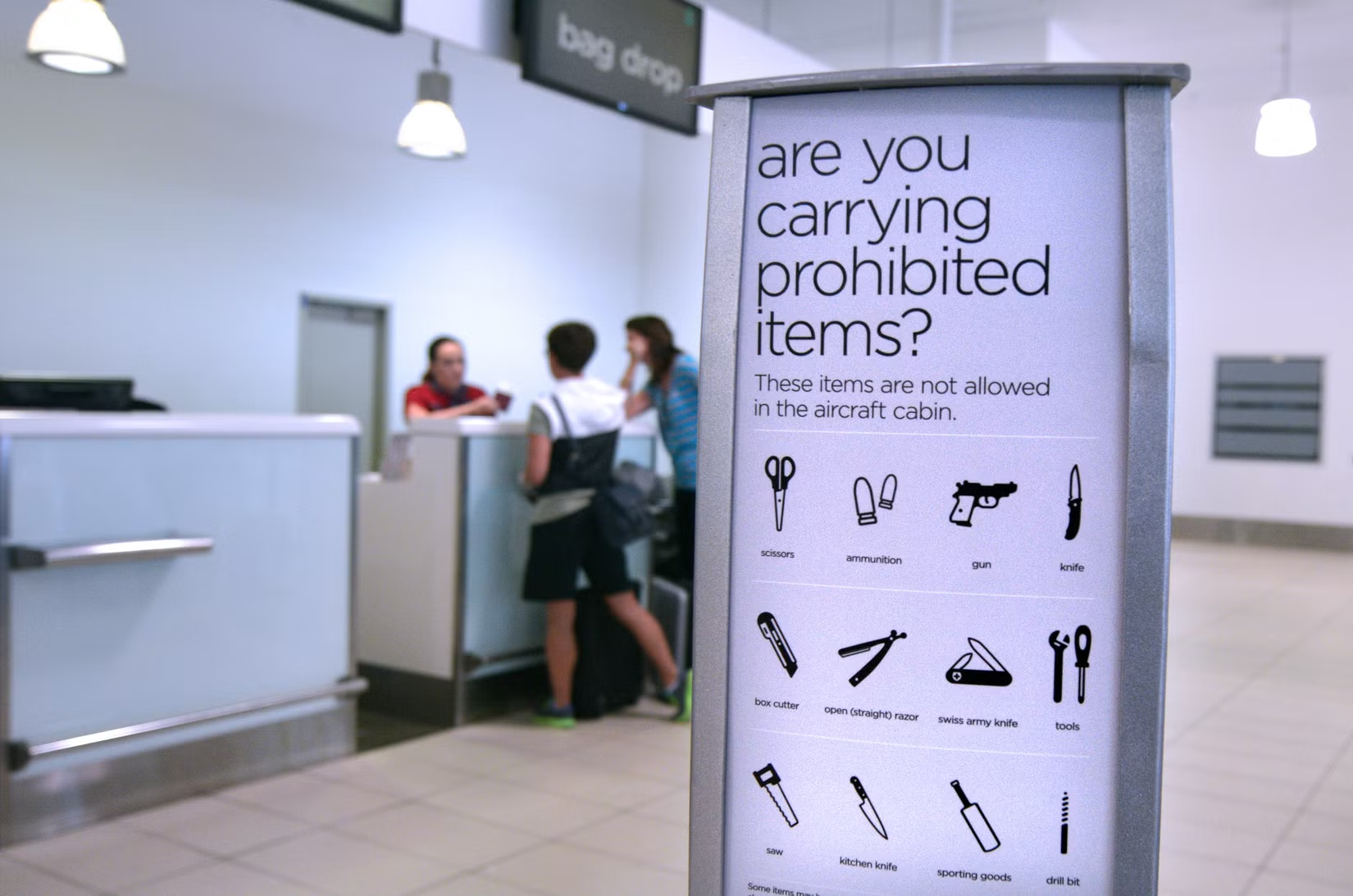
What's banned from cabin baggage specifically? Anything sharp or pointed knives of any length, scissors over 6 cm, corkscrews, sporting bats. These go in checked luggage or stay home.
Can I Carry Alcohol in Checked Baggage? (Two Different Limits, Not One)
This is where most guides give an incomplete answer by only mentioning one limit.
There are two separate ceilings that apply at different points in your journey:
- Airline limit (packing rule): Up to 5 litres per passenger, 24–70% ABV, in unopened retail packaging. Above 70% ABV is banned outright, checked or cabin.
- Customs limit (duty-free rule): Only 2 litres travel duty-free into India. If you're carrying up to 5 litres per the airline rule but it's above 2 litres, you must declare the excess at customs and pay duty on it the airline letting you check it in doesn't mean customs treats it as duty-free.
Pack bottles in sealed plastic bags, cushioned with clothing, to prevent leaks damaging the rest of your luggage.
Can I Carry Medicines and Electronics in Checked Baggage?
Medicines: Liquid medications can go in checked baggage without cabin restrictions, but always keep prescription medicines in your hand luggage with documentation if your checked bag is delayed, you still need access to what you actually take daily.
Electronics: Laptops, cameras, similar devices with batteries installed fine checked, powered off. Loose batteries and power banks: cabin only, as covered above.
Customs Baggage Rules 2026: What Changed
India's Baggage Rules 2026 replaced the 2016 framework, effective 2 February 2026.
| Rule | Old (2016) | New (2026) |
|---|---|---|
| Duty-free allowance — residents/NRIs/OCI | ₹50,000 | ₹75,000 |
| Duty-free allowance — foreign tourists | ₹15,000 | ₹25,000 |
| Gold jewellery (1+ year abroad) | Value-based cap | 40g (women) / 20g (others) — weight-based |
| Laptop allowance | Included in general limit | 1 laptop per adult, separate from ₹75,000 limit |
| Duty on excess value | Tiered, could exceed 20% | Flat 10% (effective 1 April 2026) |
| Declaration | Paper forms | Digital via Atithi app / ICEGATE |
Still excluded from duty-free treatment regardless of the new limits: cigarettes over 100 sticks, cigars over 25, tobacco beyond 125g, alcohol beyond 2 litres, gold/silver in non-jewellery form, firearms, televisions.
Work example: Electronics worth ₹1,20,000, one laptop included. The laptop is duty-free separately. The remaining goods: first ₹75,000 duty-free, the balance taxed at a flat 10%.
Reference: CBIC Baggage Rules 2026 notification verify current thresholds before travel, as limits are periodically revised.
Restricted Items: Airline-Wise Differences
Rules vary meaningfully by carrier, even on the same route this is the part travellers check least and get caught by most.
| Airline | Key Difference to Know |
|---|---|
| Air India | Spare batteries individually protected, cabin only; alcohol up to 5L (24–70% ABV), original packaging |
| IndiGo | Power banks over 160 Wh banned outright; must show visible power rating |
| Qatar Airways | Spare lithium-ion batteries capped at 100 Wh without prior approval; non-removable smart baggage batteries not accepted |
| British Airways | Spare batteries forbidden in checked baggage even if a cabin bag gets gate-checked must be removed and carried by passenger |
| Ethiopian Airlines | Ammunition must be declared at check-in with security approval; gate-confiscated items may not be returned |
Practical takeaway: if you're flying Qatar Airways or a similarly strict international carrier and your power bank exceeds 100 Wh, check the exact watt-hour rating printed on it before you leave home this single number determines whether it travels with you at all.
What Happens If Prohibited Items Are Found
- Airlines remove the item; genuinely dangerous goods can mean the whole bag is refused.
- Fines, flight bans, or criminal charges in serious cases.
- Delays affecting your flight and potentially others.
- No compensation for confiscated items travel insurance typically excludes belongings packed in violation of regulations.
When in doubt, declare. Choosing the Red Channel and paying applicable duty is significantly less costly, in money and time, than being flagged for a Green Channel violation.
Checked Baggage Packing Checklist
- Batteries, power banks, medications, documents → cabin bag, not checked
- Sharp objects → checked, wrapped/sheathed
- Liquids → sealed bags within suitcase
- Alcohol → check both airline (5L) and customs (2L duty-free) limits separately
- Smart luggage → confirm the battery is removable before check-in
- Confirm your specific airline's rules 1–2 days before departure don't assume domestic and international carriers match
Final Thoughts
The categories that actually cause problems are narrow: batteries stay in the cabin no matter what bag they're inside, sharp objects go checked but wrapped, alcohol has two limits not one, and airline rules vary enough to be worth a five-minute check before you leave. Get those right and the rest is straightforward packing.
Flying internationally soon? Shree Krishna Travel World builds baggage and customs guidance into every tour package brief, so nothing gets flagged at the counter. Talk to us about your upcoming trip.