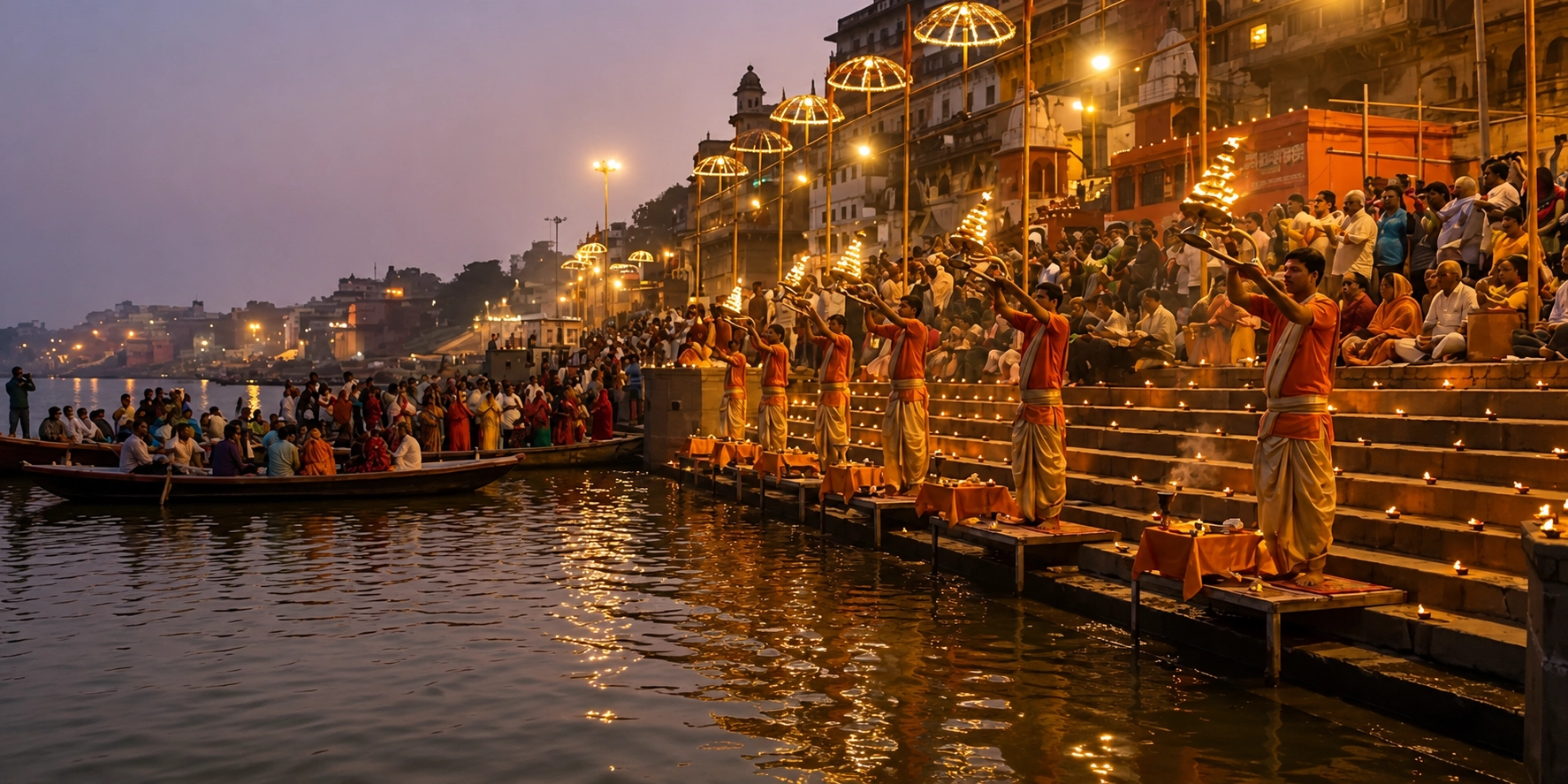
There’s a moment at Dashashwamedh Ghat, right as the sky turns the colour of a dying ember, when the crowd noise drops for just a second before the conch shells start. If you’ve timed your evening right, you’re standing close enough to feel the heat off the brass lamps. If you’ve timed it wrong, you’re squeezed at the back of a thousand people, watching the ritual over someone’s phone screen.
The difference between those two evenings usually comes down to one thing: knowing the exact Ganga Aarti timing in Varanasi for the month you’re visiting, not just “around 7 PM.”
This guide gives you that. We’ve also covered the things most Varanasi blogs skip: which ghat actually suits your travel style, what the aarti is doing minute by minute, and the two newer aarti locations that have quietly changed how the evening works in 2026.
What Exactly Is the Ganga Aarti?
The Ganga Aarti is a fire ritual performed every evening on the banks of the Ganges to honour the river as a living goddess. At Varanasi’s main ghats, a row of priests, traditionally young Brahmin men trained in the ritual, stand on raised platforms and move multi-tiered brass lamps in synchronised circular motions, accompanied by bells, conch shells, and devotional chanting.
It isn’t staged for tourists. The ritual has continued nightly for well over a century, and locals attend it as an act of daily worship, not a performance. That’s part of what makes it feel different from most cultural shows you’ll see elsewhere in India.
Ganga Aarti Timing in Varanasi: Season-Wise Schedule
Here’s the part most articles get slightly wrong: the Ganga Aarti doesn’t run on a fixed clock time, it’s tied to sunset. That’s why you’ll see the timing shift gradually through the year rather than jumping between two fixed slots.
| Season | Months | Approximate Start Time | Duration |
|---|---|---|---|
| Winter | November – March | 5:30 PM – 6:15 PM | ~45 minutes |
| Summer | April – June | 6:45 PM – 7:45 PM | ~45 minutes |
| Monsoon | July – October | 6:30 PM – 7:15 PM | ~45 minutes (weather-dependent) |
Practical rule of thumb: the aarti begins roughly 15 to 20 minutes after local sunset. If you want the exact time for your travel date, check the day’s sunset time or simply ask your hotel concierge, since Varanasi hotels near the ghats track this daily.
During the monsoon months, heavy Ganga water levels can occasionally force the ceremony to shift location slightly further back from the river’s edge, or shorten in rare cases of flooding. If you’re travelling in July to September, it’s worth confirming on the day rather than assuming the printed schedule.
There’s a Morning Aarti Too, and Almost Nobody Mentions It
Most visitors only know about the evening ceremony. Dashashwamedh Ghat also holds a morning aarti, usually around sunrise, that’s smaller, quieter, and performed as a sun salutation rather than the elaborate evening fire ritual. If you’re staying near the ghats and want an experience without any crowd at all, this is genuinely worth waking up for.
Assi Ghat takes this further with Subah-e-Banaras, a daily sunrise programme combining yoga, classical music, and prayer, a completely different mood from the evening spectacle, and one of Varanasi’s best-kept mornings.
Best Ghats to Watch the Ganga Aarti (And Who Each One Suits)
Not every visitor wants the same experience. Here’s how the main options actually compare.
| Ghat | Best For | Crowd Level | Notes |
|---|---|---|---|
| Dashashwamedh Ghat | First-time visitors wanting the full spectacle | Very High | The largest, most iconic aarti, with 7 priests and the biggest crowd |
| Assi Ghat | A calmer, more spiritual experience | Low – Moderate | Smaller ceremony; pairs well with the sunrise programme |
| Rajendra Prasad Ghat | Great photography, less crush | Moderate | Right next to Dashashwamedh, similar timing, thinner crowd |
| Lalita Ghat | Pilgrims visiting Kashi Vishwanath | Low – Moderate | A newer daily aarti held right below the temple’s entrance, very convenient if you’re combining temple darshan and aarti in one evening |
| Namo Ghat | Families and international travellers wanting comfort | Low | Modern, spacious, well-lit riverfront, the easiest ghat to navigate if you’re avoiding narrow lanes and stairs |
Our honest take: if this is your first Varanasi trip, watch the first evening’s aarti from a boat facing Dashashwamedh Ghat, then walk the ghats on foot the following evening. The boat gives you the full visual, all the priests in one frame, reflected on the water, without the physical crush of the crowd. Walking the ghats afterwards gives you the atmosphere you can’t get from the water: the smell of incense, the temple bells, the chai stalls.
Common Mistakes First-Time Visitors Make
- Arriving “on time” instead of early. The published start time is when the ritual begins, not when you should arrive. Ghats fill up 45 to 60 minutes before, especially on weekends, Kartik Purnima, and Dev Deepawali.
- Not checking the season-specific time. A traveller who checks a January travel blog in June will show up an hour early or late.
- Booking a boat without asking where it anchors. Not all “aarti boat” bookings guarantee a front-row spot at Dashashwamedh. Ask specifically before paying.
- Skipping the morning ghats entirely. The Ganga at 6 AM, with mist over the water and boats gliding past bathing pilgrims, is arguably as memorable as the evening aarti, and almost nobody plans for it.
- Wearing flashy or revealing clothing. This is an active religious ritual, not a tourist show. Modest clothing is appreciated, especially if you plan to also visit Kashi Vishwanath Temple.
Sample Evening Plan Around the Aarti
If you want to build your evening around the Ganga Aarti without a wasted hour, this works well in most seasons.
- 90 minutes before aarti: Visit Kashi Vishwanath Temple, going early to avoid the darshan queue building up before evening.
- 60 minutes before: Walk the ghats from Assi towards Dashashwamedh, or head straight to your boat pickup point.
- 45 minutes before: Take your position, whether ghat steps or boat, as this is when the best spots start disappearing.
- Aarti begins: Sit back and watch, and resist the urge to spend the whole ritual filming it on your phone.
- After the aarti: Ghat-side chai stalls and a short walk through the old city lanes (Vishwanath Gali) make for a fitting close to the evening.
Beyond the Aarti: What Else Kashi Offers
Varanasi rewards travellers who give it more than one evening. A few places worth building into your itinerary:
- Kashi Vishwanath Temple – one of the twelve Jyotirlingas, and the spiritual anchor of the city
- Sarnath – a short drive away, where the Buddha delivered his first sermon; a peaceful contrast to the intensity of the ghats
- Manikarnika Ghat – one of Hinduism’s most sacred cremation grounds; visit respectfully and avoid photography
- Banaras Hindu University – home to the Bharat Kala Bhavan museum, worth an afternoon for art and history
- A dawn boat ride – best booked the evening before, departing around 5:30 to 6:00 AM to catch sunrise over the ghats
A quiet sunrise on the ghats, with mist rising off the water and pilgrims taking their morning dip, is a completely different side of Varanasi from the evening crowds, and one worth setting an early alarm for at least once during your trip.
Varanasi Tour Packages by Shree Krishna Travel World
Since 1999, Shree Krishna Travel World has been planning spiritual and heritage journeys across India, and our Varanasi Spiritual Trail package is built specifically around getting the Ganga Aarti timing right, along with temple darshan, sunrise boat rides, and Sarnath, without the guesswork of figuring it out on arrival.
Whether you’re travelling solo, with family, or planning a larger pilgrimage group, we handle the details, hotel proximity to the ghats, aarti seating, and local guides, so your Kashi trip runs on Kashi’s schedule, not a generic itinerary.
Ready to plan your Varanasi trip? Get in touch with our travel desk or explore our Varanasi Spiritual Trail package for a fully planned itinerary built around the aarti, the temples, and the ghats. If the Himalaya is next on your list, take a look at our Char Dham Yatra in the Himalaya package too.