There’s a particular sound that hits you first, before you even see the river. Bells. Dozens of them, ringing out of rhythm at the start and then, somehow, falling into one another. That’s how you know the Ganga Aarti has begun in Rishikesh.
If you’re planning a trip around this ritual, you probably already know the basics: it happens at sunset, it’s free, and it happens near the Ganga. What most guides skip is everything that actually shapes whether your evening feels magical or feels like standing in a crowd you can’t see over. This guide fills that gap, based on how the aarti actually runs, not just what a schedule says. If you’d rather have the details handled for you, our Rishikesh Tour Package builds an evening exactly around this ritual.
Quick Facts: Ganga Aarti in Rishikesh
| Best Ghat | Parmarth Niketan |
| Alternate Ghat | Triveni Ghat |
| Entry Fee | Free |
| Best Arrival Time | 30–45 minutes early |
| Morning Aarti | Available, 5:30–7:00 AM (season dependent) |
| Evening Aarti | Sunset, roughly 5:15–7:45 PM (season dependent) |
| Boat Ride | ₹100–₹400 per person, optional |
| Photography | Allowed, avoid continuous flash |
| Dress Code | Modest, shoulders and knees covered |
| Nearest Landmark | Ram Jhula (Parmarth) / Rishikesh town centre (Triveni) |
What Exactly Is the Ganga Aarti?
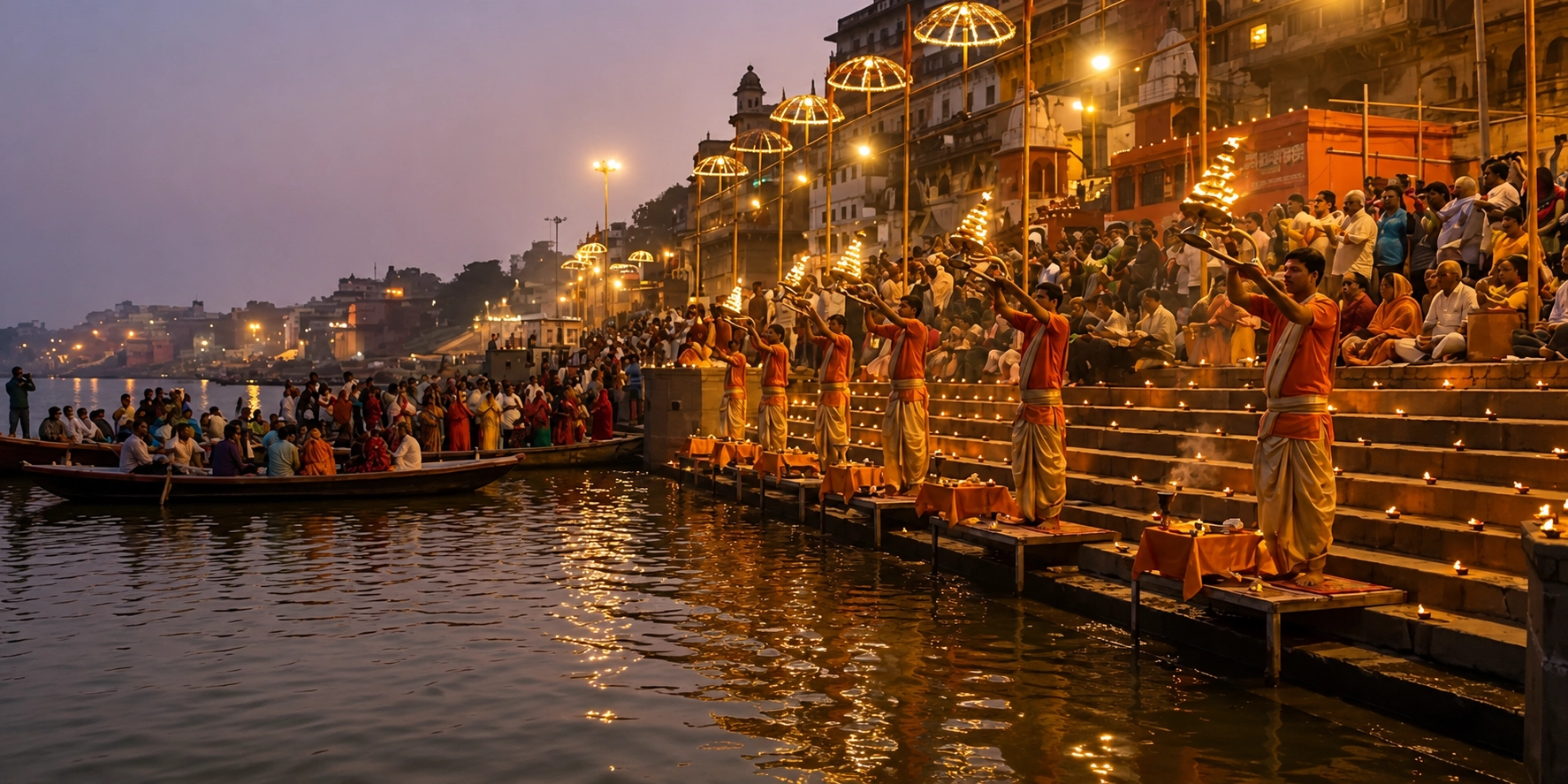
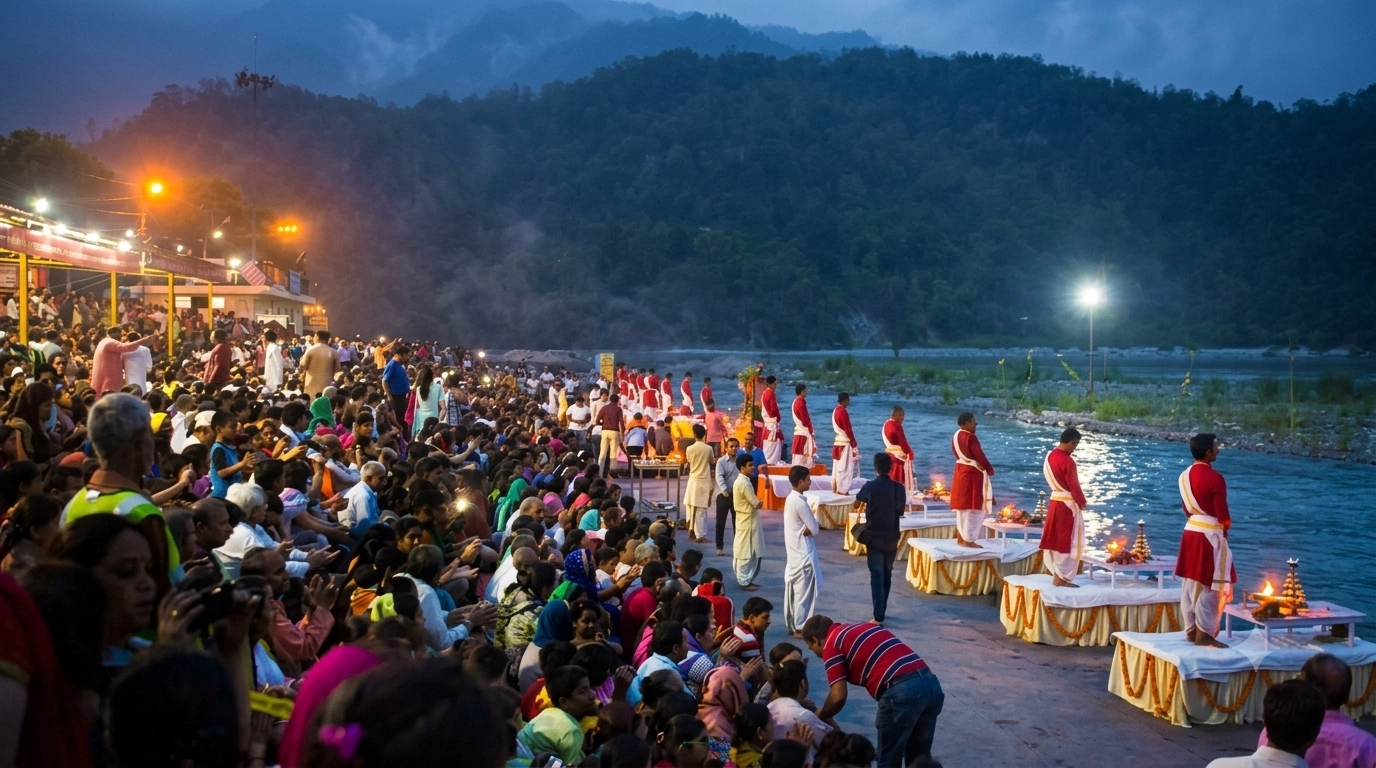
Ganga Aarti is a devotional fire ritual offered to the river Ganga at dusk. Priests, and at Parmarth Niketan, young ashram students known as Vedpathis, stand at the water’s edge with multi-tiered brass lamps. They move the flames in circular patterns while Sanskrit hymns and conch shells play in the background. Visitors are welcome to join in, and many people release small flower-and-diya boats onto the water as an offering.
It isn’t a performance staged for tourists. It’s a genuine daily ritual that tourists happen to be allowed to witness. That distinction matters for how you should behave once you’re there, and we’ll come back to it.
Ganga Aarti Timings: Today, Summer and Winter
The aarti is tied to sunset, not a fixed clock. That’s the detail most timing tables leave out, and it’s the reason your neighbour’s “6 PM sharp” tip might land you at an empty ghat 20 minutes early or a crowded one 20 minutes late.
If you want today’s exact timing: the aarti begins at local sunset and runs for 45 to 60 minutes. Search “Rishikesh sunset time today” the evening before, then plan to arrive 30 to 45 minutes ahead of that.
If you’re planning around a season, here’s the general pattern.
| Season | Approximate Sunset | Evening Aarti Window | Morning Aarti |
|---|---|---|---|
| Summer (Apr–Jun) | 7:00–7:15 PM | 6:45–7:45 PM | 5:30–6:15 AM |
| Monsoon (Jul–Sep) | 6:45–7:00 PM | 6:30–7:30 PM | 5:45–6:30 AM |
| Autumn (Oct–Nov) | 6:00–6:15 PM | 5:45–6:45 PM | 6:00–6:45 AM |
| Winter (Dec–Feb) | 5:30–5:45 PM | 5:15–6:15 PM | 6:15–7:00 AM |
A safer rule than memorising a time slot: check the local sunset for your travel date a day before you go, then plan to be seated 30 to 45 minutes before that. Hotels and homestays in the area will confirm this for you without hesitation if you ask at check-in.
Insider tip: The morning aarti is the one almost nobody plans for, and it’s often the more moving of the two. Fewer tourists, more actual devotees, and a river that’s still cold and quiet from the night before.
Where to Watch It: Parmarth Niketan vs Triveni Ghat
Both are on the river, both are free, and both draw crowds. But they are not interchangeable experiences.
Parmarth Niketan sits inside an ashram at Swargashram, close to Ram Jhula. This is the aarti most people picture: rows of young priests in saffron, coordinated lamp movements, and a giant Shiva statue watching over the river. It has been performed nightly since 1997 without a break, and it’s built around structured seating on ashram steps, which makes it easier for families and older travellers to settle in comfortably.
Triveni Ghat is Rishikesh’s older, more local ghat, closer to the main town and the market. It has less of the choreographed polish and more of the everyday devotional energy: local families doing puja, priests who’ve been doing this for decades, and a rougher, more textured riverside. If Parmarth feels like a ceremony, Triveni feels like a neighbourhood ritual you’ve been let in on.
| What You Want | Better Choice |
|---|---|
| Structured seating, families with kids | Parmarth Niketan |
| A quieter, more local feel | Triveni Ghat |
| Photography with a dramatic backdrop | Parmarth Niketan (Shiva statue, symmetry) |
| Combining with a market walk or street food | Triveni Ghat |
| First visit to Rishikesh | Parmarth Niketan |
| You’ve done Parmarth before, want something different | Triveni Ghat |
Honestly, if your schedule allows it, don’t choose. They’re a 15 to 20 minute walk or a short auto ride apart, and seeing both across two evenings gives you a far more complete picture of what devotion looks like here than picking just one.
Where Are the Ghats Located?
- Parmarth Niketan: Swarg Ashram, near Ram Jhula
- Triveni Ghat: Mayakund, central Rishikesh
Both ghats sit on the same stretch of river, roughly 3.5 km apart by road. If you’re staying in Tapovan or Muni Ki Reti, you’re within easy auto-rickshaw or walking distance of either one, which is exactly why that stretch of town is worth prioritising when you book a stay.
Ganga Aarti Etiquette: What Most Guides Don’t Tell You
This is the part travel blogs consistently underplay, and it’s the part that actually affects your experience.
- Dress modestly. Shoulders and knees covered, for both men and women. A light stole or dupatta over a t-shirt works fine in summer heat.
- Don’t turn your back to the river during the ritual. It’s considered disrespectful. If you need to leave mid-aarti, step back quietly rather than walking directly away from the water.
- Keep flash photography minimal. A few respectful shots are fine; treating it like a photoshoot with continuous flash pulls attention away from the priests and irritates people around you.
- If you’re offered prasad or asked to participate in a small ritual gesture, it’s okay to accept or politely decline. Neither is rude.
- Remove footwear before stepping onto the main ghat platforms; most areas have a designated spot for this.
- Silence isn’t mandatory, but volume is noticed. Quiet conversation is fine; loud phone calls during the aarti draw stares for good reason.
None of this is complicated, but travellers who skip it tend to be the ones who feel like the ritual “didn’t land” for them. Respecting the rhythm of it is half the experience.
Common Mistakes First-Time Visitors Make
- Showing up right at the listed start time. By then, every good vantage point on the steps is taken.
- Assuming both ghats run on the exact same schedule. They’re close but not identical; always confirm both if you’re choosing between them on the day.
- Wearing sandals that are hard to slip on and off. You’ll be removing footwear more than once during an evening in Rishikesh.
- Skipping the walk across the river afterward. Ram Jhula and Laxman Jhula are lit up beautifully once the aarti ends, and most visitors head straight back to their hotel instead.
- Not carrying cash. Diyas, flower offerings, and small vendor stalls near the ghats are mostly cash transactions, typically ₹10 to ₹30 per offering.
- Booking a hotel far from both ghats to save money. The Muni Ki Reti and Tapovan stretch keeps you walkable to both, and the time saved is worth more than the fare saved on autos.
Combining Ganga Aarti with the Rest of Rishikesh
Most travellers don’t fly or take a two-day train ride just for one evening ritual, and you shouldn’t have to plan it that way either. Rishikesh rewards a two to three day stay.
A realistic two-day flow:
- Day 1 afternoon: Arrive, settle in near Tapovan or Muni Ki Reti, walk across Laxman Jhula
- Day 1 evening: Ganga Aarti at Parmarth Niketan
- Day 2 morning: Optional white-water rafting (seasonal, typically open September to June) or a visit to the Beatles Ashram
- Day 2 evening: Ganga Aarti at Triveni Ghat, followed by a walk through the local market
If your trip is part of a longer Char Dham Yatra or a Haridwar-Rishikesh-Uttarakhand loop, Rishikesh works well as either your opening or closing stop, since it’s a manageable drive from both Haridwar and Dehradun.
Festival Dates Worth Knowing
The aarti happens every single evening, but a handful of dates turn it into something bigger.
- Kartik Purnima (usually October/November): Thousands of extra diyas float on the river; arrive an hour early
- Dev Diwali: Ghats are lit end to end with lamps; one of the most photogenic nights of the year here
- Maha Shivratri: Larger crowds, extended ceremonies at Parmarth Niketan
If your travel dates happen to overlap with any of these, plan for significantly heavier footfall and arrive well ahead of your usual buffer.
What to Pack for an Evening Aarti
- Light stole or shawl (covers shoulders, doubles as evening warmth in winter)
- Easy slip-on footwear
- Small cash in ₹10–₹50 notes
- A power bank (charging points near the ghats are limited)
- A light jacket if visiting October through February; river-side evenings get cold fast
- Mosquito repellent during monsoon months
Budget Snapshot for an Aarti Evening
| Item | Typical Cost |
|---|---|
| Entry to aarti (both ghats) | Free |
| Flower/diya offering | ₹10–₹30 |
| Auto-rickshaw between ghats | ₹50–₹100 |
| Street food near Triveni Ghat market | ₹100–₹250 |
| Optional boat ride viewing | ₹100–₹400 per person |
None of this needs to be booked in advance. It’s cash-and-walk-up, which is part of what keeps the experience feeling unpolished and genuine rather than commercialised.
Best Time to Visit Rishikesh
The aarti happens every evening regardless of season, but the rest of your trip is shaped by when you go.
- October to March is generally considered the best window. The weather is cool and comfortable, river-side walks are pleasant, and it lines up with festival dates like Kartik Purnima and Dev Diwali.
- April to June brings warmer days but is still workable for a short trip, especially if you’re combining the aarti with rafting, which runs strong through this period.
- July to September is monsoon season. The river runs faster and higher, rafting is usually suspended, and the ghats can get slippery, but the crowds thin out considerably and the aarti itself takes on a quieter, more atmospheric feel.
- Weekdays over weekends, if you have the flexibility. Both ghats get noticeably busier on Saturday and Sunday evenings, and even more so around long weekends.
If you’re combining Rishikesh with a Char Dham trip, note that the Char Dham season generally runs from late April to early November, so the timing of your Ganga Aarti visit may naturally align with one end of that yatra window. Our Uttarakhand Packages can help you plan the full loop around it.
Getting to Rishikesh
Rishikesh is well connected by road and rail through Haridwar, and by air through Jolly Grant Airport in Dehradun, roughly 35 to 40 minutes away by cab. If you’re travelling as part of a group or family and don’t want to manage train transfers, connecting buses, and last-mile autos on your own, this is exactly the kind of logistics Shree Krishna Travel World handles as part of its Haridwar-Rishikesh loop and Char Dham packages, so your evening at the ghat is the only thing you have to think about.
Plan Your Rishikesh Trip Around the Ghats, Not the Guesswork
Planning a trip to witness the Ganga Aarti in Rishikesh? Shree Krishna Travel World puts together complete Rishikesh and Uttarakhand itineraries, from ghat-side stays to transport and add-on experiences, so you can focus on the evening ritual instead of the logistics. Get in touch with our travel experts today to build your custom Rishikesh itinerary.